Slowly but steadily the results of the PaNDiv experiment start to be available. With many helping hands we piled up data about fungal infection, plant traits, community composition, biomass etc. and are now putting the pieces of the puzzle together. In the latest preprint we show that the functional composition of a plant community is a main driver of fungal infection and that the consequences of fungal infection are context dependent.
Sick plants in grassland communities, Cappelli et al. 2019 (preprint)
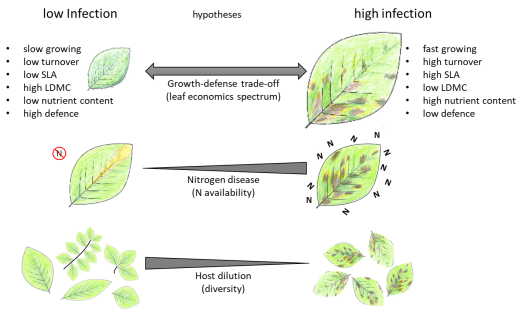
Figure 1 Overview over the main hypotheses which we tested. Growth-defense trade-off hypothesis: Plant species adapted to resource-rich environments and able to compete well under nutrient rich conditions are often less defended against natural enemies. Nitrogen disease hypothesis: Higher nutrient content of the plant material following nitrogen fertilization should promote disease. Host dilution hypothesis: Many pathogens are dependent on the availability and density of host plants. At high plant diversity the abundance of each host plant is in average lower than in species poor communities, which is suggested to be the underlying mechanism of observed negative diversity-disease relationships.


 Allan Ecology Lab
You must be logged in to post a comment.