
Project by Cornelia Witschi, Master Student
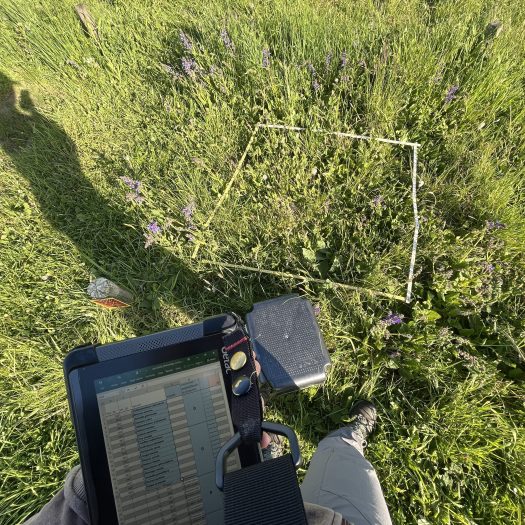
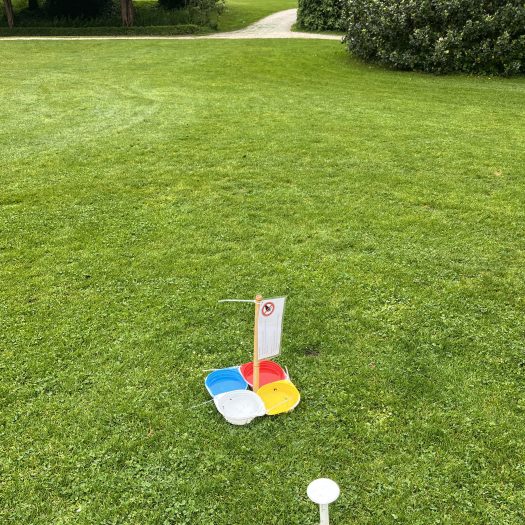
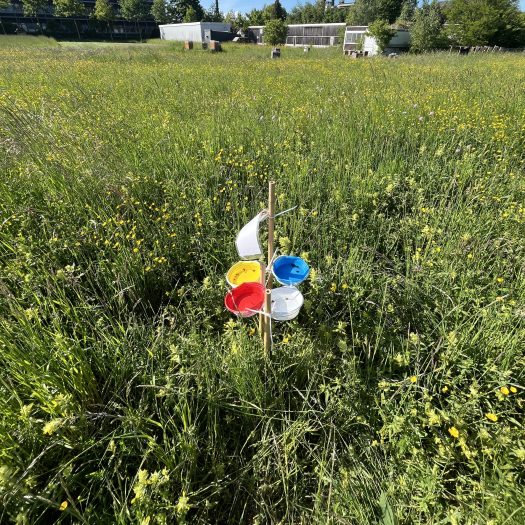
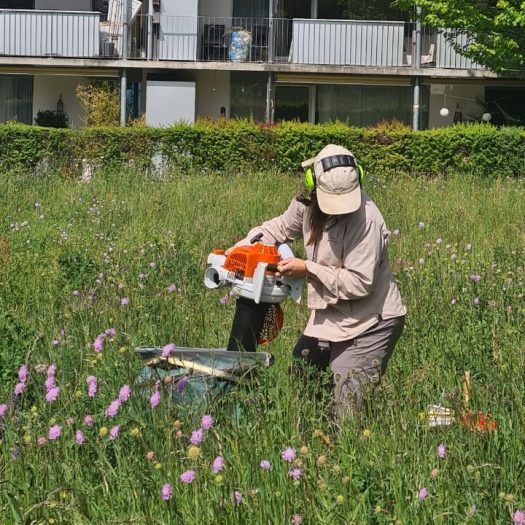
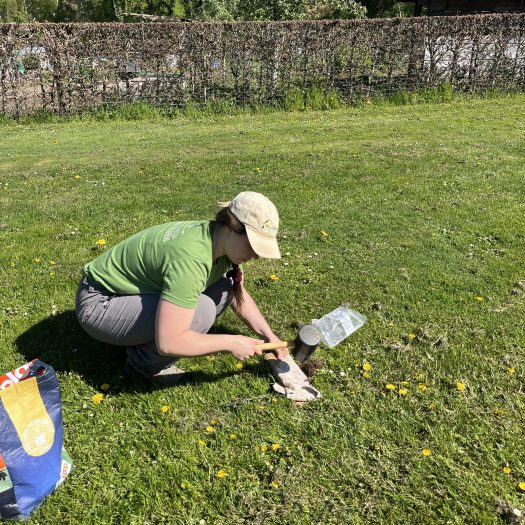
Pictures from left to right – top: Vegetation cover, PanTraps for pollinators – cut lawn, Pan Traps for pollinators – grassland patch; bottom: Suction sampling for insect sampling, Soil Sampling for Carbon analysis
Die deutsche Version findet ihr weiter unten.
Urban populations are growing worldwide, along with the need for healthy and functional green spaces that are efficient and sustainable under the pressures of climate change.
The city of Bern has designed several surfaces and structures to serve as refuges for biodiversity, offering an opportunity to study how small areas can strengthen local ecological processes.
For this project, we are focusing on the small-to-medium patches of grasslands that are purposely managed to sustain more diversity of plants and attract diverse organisms such as insects that act as pollinators.This may not only be beneficial for biodiversity itself, but also for humans, which means an increase in the Ecosystem Services provided by them.
During spring and summer 2026, we will be measuring several functions that occur in these grasslands to compare them to traditional lawns in the city of Bern. We will measure soil carbon, soil temperature, plant diversity, root productivity, flower cover, and pollinator and insect diversity in 30 grasslands and lawns. Particularly, pollinators will be sampled using Pan traps. This is the only method that allows us to understand what pollinators are associated with each surface. Their populations are not affected by this sampling, and our ultimate goal is to promote their conservation. We will also conduct surveys with citizens to gain a better understanding of what they expect from these green spaces.
Hopefully, this work will allow us to better understand what services are provided by grasslands in an urban context. And ultimately to help plan an efficient use of public spaces in cities.
For further information contact Cornelia, cornelia.witschi@students.unibe.ch
Projekt zu urbanen Grünflächen
Die Stadtbevölkerung wächst weltweit, und damit auch der Bedarf an gesunden und funktionalen Grünflächen, die unter dem Druck des Klima Wandels effizient und nachhaltig sind.
Die Stadt Bern hat verschiedene Flächen und Strukturen als Rückzugsgebiete für Biodiversität konzipiert und bietet damit die Möglichkeit zu untersuchen, wie kleine Grünflächen lokale ökologische Prozesse stärken können.
In diesem Projekt konzentrieren wir uns auf kleine bis mittelgrosse Grünflächen, die gezielt bewirtschaftet werden, um eine grössere Pflanzenvielfalt zu erhalten und verschiedene Organismen wie beispielsweise bestäubende Insekten anzulocken. Dies kann nicht nur der Biodiversität selbst zugutekommen, sondern auch dem Menschen, da die von ihnen bereitgestellten Ökosystemleistungen steigen.
Im Frühling und Sommer 2026 werden wir verschiedene Funktionen dieser Grünflächen messen und sie mit herkömmlichen Rasenflächen in Bern vergleichen. Wir werden Bodenkohlenstoff, Bodentemperatur, Pflanzenvielfalt, Wurzelproduktivität, Blütenbedeckung sowie die Vielfalt von Bestäubern und Insekten in 30 Grünflächen und Rasenflächen messen. Bestäuber werden mithilfe von “Pan traps” erfasst. Dies ist die einzige Methode, die es uns ermöglicht, die auf den jeweiligen Flächen vorkommenden Bestäuber zu bestimmen. Ihre Populationen werden durch die Probenahme nicht beeinträchtigt, und unser oberstes Ziel ist ihr Schutz. Wir werden ausserdem Umfragen durchführen, um besser zu verstehen, was die Bevölkerung von diesen Flächen erwartet.
Wir hoffen, dass uns diese Arbeit dabei hilft, die Funktionen von Grünflächen im urbanen Raum besser zu verstehen und letztendlich eine effizientere Nutzung öffentlicher Räume in Städten zu planen.
Für weitere Information kontaktieren Sie bitte Cornelia, cornelia.witschi@students.unibe.ch


You must be logged in to post a comment.